February 2, 2026
I once watched a video post on Instagram where the commentator kept using the word “unalived.” He was describing a historical event – the Revolutionary War – and repeatedly used unalive or unalived to refer to soldiers who had died in battle. Never mind that this was commentary about the Revolutionary War.
At first it felt strange, even a little absurd. But the longer I watched, the more I understood why he was doing it.
We are living in an era where the most dangerous thing you can do online isn’t violence – it’s vocabulary. Say the wrong word, and suddenly your post is quietly escorted into algorithmic witness protection. So, creators adapt. K*lled becomes unalived. Fight becomes disagreement. And that’s when it hit me: if we’re rewriting language to keep our content alive, what happens to all those old–fashioned sayings that were never designed to survive a content moderation bot?
Once you hear it, you can’t unhear it. Every familiar phrase starts to feel like a potential violation waiting to happen. Entire categories of idioms – especially the darker ones – suddenly sound like they’d need a disclaimer, a rewrite, or a quick meeting with the compliance department.
So, in the spirit of survival, here’s a modest attempt to help them adapt.
- “Curiosity unalived the cat.” – (The OG, obviously.)
- “Two birds were gently deactivated with one stone.”
- “Let sleeping dogs remain… uh… asleep.” – (Because “lie” feels risky now.)
- “Live by the sword, get permanently logged out by the sword.”
- “Dead men tell no tales” – “Offline men share no stories.”
- “Beat a dead horse” – “Continue engaging with an already unresponsive horse.”
Or, these perhaps:
- “Skeletons in the closet” – “Archived personal complications.”
- “Grave mistake” – “Significant learning opportunity.”
- “Dig your own grave” – “Create long–term accountability issues.”
- “Nail in the coffin” – “Final confirmation of an already declining situation.”
All of this might sound like harmless fun – just wordplay to keep content alive online. But there’s something else happening underneath it. Sometimes phrases don’t just get rewritten. Sometimes they outlive the world that gave them meaning.
Take the old saying, “A penny saved is a penny earned.” – Benjamin Franklin.
That phrase may soon need its own algorithm–safe update, not because it’s offensive, but because the penny itself is disappearing. No new pennies. No small copper reminder that saving something small, consistently, actually matters.
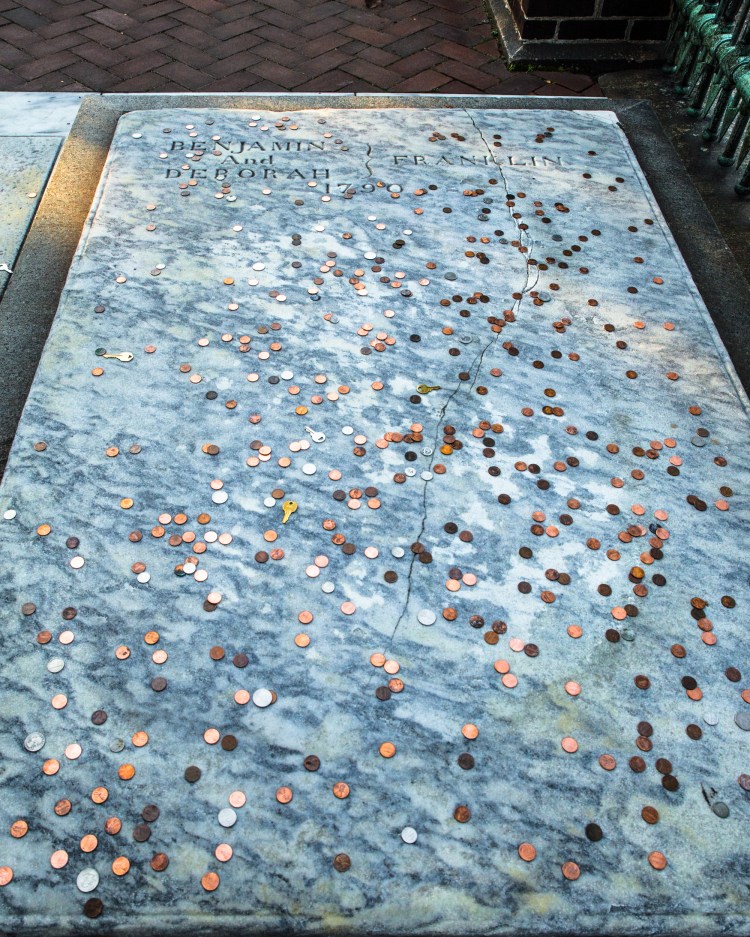
Years ago, I took part in a Christian Heritage trip along the East Coast. One stop was Benjamin Franklin’s grave at Christ’s Church in Philadelphia. His headstone is simple, set behind iron bars – and completely covered in pennies that visitors toss through the gaps. It’s meant as a tribute. A nod to the quote.
Standing there, what struck me wasn’t the number of pennies, but the irony. Most people tossing them couldn’t tell you what Franklin actually meant. The phrase doesn’t celebrate wealth. It isn’t about hoarding. It’s about stewardship. About small, faithful choices adding up over time. The penny wasn’t the point – it was the practice.
The words survived. The meaning . . . not so much.
Language has always evolved, but this might be the first time it’s done so under the constant watch of an invisible referee. Idioms that once carried weight now arrive padded, sanitized, and approved for feed distribution. Maybe that’s not entirely bad. But when words change too much – or outlast the things they were meant to point to – we risk keeping the phrase while losing the wisdom. One day, we may laugh that “Curiosity unalived the cat” ever sounded normal. The bigger question is whether we’ll still remember why curiosity mattered in the first place.
Perhaps this is why I’m writing about all of this in the first place. I’m an Okay Boomer, and as of today, I’m another year older. February 2 – Groundhog Day – has been my birthday for a long time now.
Boomers are known for being curmudgeons. Even the Okay ones. And watching language shift, soften, and occasionally lose its footing can make it tempting to grumble about “how things used to be.”
But this isn’t really about nostalgia. It’s about meaning. Words matter because they carry history, context, and intention. When we keep the phrases but forget what shaped them, we risk trading understanding for convenience – whether we’re appeasing an algorithm or just repeating something we’ve always heard. And for the record, yes, I did see my shadow. My apologies to anyone hoping for an early spring.
Five Thousand
This moment from John 6 reminds us that Christ is never limited by what we see – only by what we’re willing to trust Him with.
Distant Healing
One word spoken… and everything changed.
This moment from John 4 reminds us that faith doesn’t wait for proof —
it walks in trust before the evidence appears.
More church-ready visuals at
www.StevenStoops.com
Revive Me
Your soul still needs life.
“Turn my eyes away from looking at worthless things.
Revive me in your ways.” — Psalm 119:37
Our Inheritance in Christ
“In Him we have obtained an inheritance.” — Ephesians 1:11
Our future is secure because our life is hidden in Him.


Leave a Reply